Infant Supernovae#
The sample#
Every supernova class of the Standard Run (Ia, Ib, Ic, Ic-BL, IIP, IIb and the SLSNe) is sampled over only the 72 hours after explosion, since an infant supernova is caught in its first days. Events are generated at their true rate, with no downsampling, and observed against the UVEX survey schedule. Two screens reduce them to the detected sample:
a loose 23 AB magnitude screen on the peak, which discards events too faint for UVEX to see in the window,
a 5 sigma detection in at least one observation in the window, ignoring an event whose only detection is the first-ever visit to its field.
The photometry of the events that survive covers the 30 days before the explosion (the survey’s observations of the position before there was a source, which give the non-detections and limits that bracket the rise) and the 100 days after it, so every light curve shows its full evolution. The brighter selection that makes an event an infant is applied afterwards, to these tables, so the definition can be changed without regenerating the run.
What is an infant supernova?#
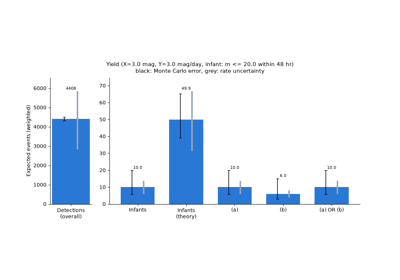
To make sure spectroscopic follow-up is possible, the event must reach 20 AB or brighter in a 5 sigma detection within 48 hours of the last non-detection in the same band. To trigger on one early, the alert stream needs a cut that can be applied to the first detection, and an event is triggered if either of two conditions holds on a 5 sigma detection within 48 hours of the last non-detection:
it has brightened by at least a given number of magnitudes since the limit of that non-detection,
it is brightening at at least a given rate, in magnitudes per day, since that limit.
The analysis below counts the infants and the triggers, and shows the light curves of triggered events.