Standard Run#
The sample#
The simulation draws Monte Carlo events of every registered transient class, with each class using its own default rate, redshift limit and duration (see Transients for the model and rate of each):
Type I supernovae: Ia, Ib, Ic and the broad-lined Ic-BL,
Type II supernovae: IIP (a fraction of which have an early excess), and IIb,
Superluminous supernovae (the magnetar-powered SLSN-I),
Exotic transients: tidal disruption events, low-luminosity GRBs (llGRBs), luminous fast blue optical transients (LFBOTs) and kilonovae.
Events are placed on the sky and in time by sampling the volumetric rate over the whole survey, and then observed
against the real UVEX survey schedule (the scheduler release pinned in the config, so the data products are
reproducible) with the uvex_fast mission model. To keep the highest-rate populations tractable the events are
downsampled by a factor of 20 (generate.downsample), and every count is rescaled back automatically, so the
numbers on these pages are expected UVEX events. Each Monte Carlo event stands for \(\mu_0 / n\) real ones,
with \(n\) the number generated and \(\mu_0\) the number that exist in UVEX’s footprint and observing
window, and the finite sample is carried through as a Monte Carlo uncertainty (see Yield Statistics).
What is a detection?#
Two screens, applied in order, reduce the generated events to the detected sample that every page starts from:
Screen |
What it keeps |
|---|---|
Magnitude ( |
Events that could ever peak brighter than 25 AB. This ignores the schedule and only discards events too faint for UVEX to ever see, to save work in the next step. |
Detection ( |
Events with at least one observation after the explosion, in at least one band (FUV or NUV), whose
signal-to-noise ratio exceeds 5. An event whose only such observation is the first-ever visit to
its field is dropped, since there is no reference image to detect it against
( |
A detection says that UVEX sees the event. It does not mean the event can be classified.
What is a characterized event?#
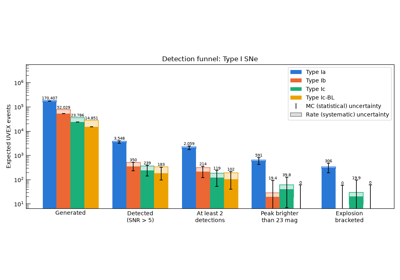
The characterization pages apply three further cuts to the detected events. They are applied here, to the event summary table, and are not part of the run, so they can be changed without regenerating it (Transient Characterization has a page with every setting in one place):
Cut |
What it keeps |
|---|---|
Repeat detections |
At least 2 detections. A lone detection is hard to tell apart from noise or an artifact. |
Bright peak |
A highest-SNR measurement brighter than 23 AB. |
Bracketed explosion |
A gap from the last constraining non-detection to the first detection that is shorter than a limit per type (from 1 day for llGRBs to 60 days for SLSNe), so the explosion time is pinned down. |
These are relatively relaxed cuts. They choose events that UVEX gets UV coverage of and that can probably be classified, but probably not early.
The pages below follow the order of the analysis: first what is detected, then what can be characterized.
Event Detection#
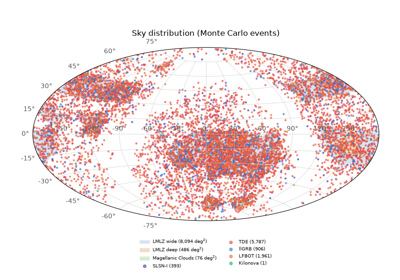
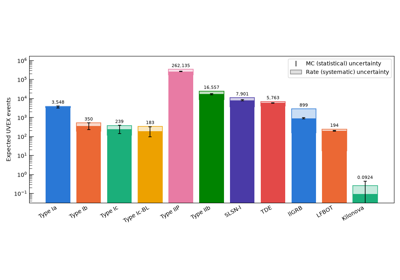
How many events of each type UVEX detects, how often it detects each one, and where on the sky they are. Here an event counts as detected with no further selection, as in the report’s Transient Detection Report, so these pages are the upper bound on what can be studied.
Transient Characterization#
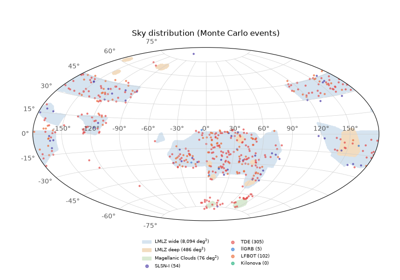
A detection is not yet a characterization. These pages apply the standard selection cuts to the detected events, to keep the ones with enough repeat detections, a bright enough peak and a tightly bracketed explosion time to be classified, and then repeat the detection analysis on what is left.