

Note
Go to the end to download the full example code.
Cut: Arbitrary Query#
filter_by_query() cuts an
~uvex_transients.simulation.event_catalog.EventCatalog by an arbitrary boolean
expression over its own columns, each bound to its own native type
(~astropy.units.Quantity, ~astropy.coordinates.SkyCoord, ~astropy.time.Time, or a
plain array), so comparisons stay unit- and frame-aware. It is the escape hatch for a
cut none of the named ones cover.
from matplotlib import pyplot as plt

from uvex_transients.missions import uvex_fast as uvex
from uvex_transients.simulation.core import SurveySimulator
from uvex_transients.surveys import get_schedule
from uvex_transients.transients.supernovae import MagnetarSLSNe
from uvex_transients.utils.plotting import resolve_fig_axes, set_plot_style

set_plot_style()

schedule = get_schedule()
slsn = MagnetarSLSNe()
simulator = SurveySimulator(schedule, transients={"slsn": slsn}, simulation_seed=42)

TIME_BINS = 10
NSIDE = 32
DOWNSAMPLE = 50

catalog = simulator.generate_events(time_bins=TIME_BINS, nside=NSIDE, sampling_factor=1 / DOWNSAMPLE)
print(f"{len(catalog) * DOWNSAMPLE} events sampled.")
Generating events:   0%|          | 0/10 [00:00<?, ?bin/s]
Generating events:   0%|          | 0/10 [00:00<?, ?bin/s, bin=1/10, type=slsn]

Building HEALPix coverage index for (nside=32, order='nested'); this can be slow for a long schedule.

Generating events:   0%|          | 0/10 [00:00<?, ?bin/s, bin=1/10, type=slsn]
Generating events:  10%|█         | 1/10 [00:07<01:07,  7.49s/bin, bin=1/10, type=slsn]
Generating events:  10%|█         | 1/10 [00:07<01:07,  7.49s/bin, bin=2/10, type=slsn]
Generating events:  20%|██        | 2/10 [00:07<00:59,  7.49s/bin, bin=3/10, type=slsn]
Generating events:  30%|███       | 3/10 [00:07<00:52,  7.49s/bin, bin=4/10, type=slsn]
Generating events:  40%|████      | 4/10 [00:07<00:08,  1.45s/bin, bin=4/10, type=slsn]
Generating events:  40%|████      | 4/10 [00:07<00:08,  1.45s/bin, bin=5/10, type=slsn]
Generating events:  50%|█████     | 5/10 [00:07<00:07,  1.45s/bin, bin=6/10, type=slsn]
Generating events:  60%|██████    | 6/10 [00:07<00:05,  1.45s/bin, bin=7/10, type=slsn]
Generating events:  70%|███████   | 7/10 [00:07<00:02,  1.45bin/s, bin=7/10, type=slsn]
Generating events:  70%|███████   | 7/10 [00:07<00:02,  1.45bin/s, bin=8/10, type=slsn]
Generating events:  80%|████████  | 8/10 [00:07<00:01,  1.45bin/s, bin=9/10, type=slsn]
Generating events:  90%|█████████ | 9/10 [00:07<00:00,  1.45bin/s, bin=10/10, type=slsn]
Generating events: 100%|██████████| 10/10 [00:07<00:00,  2.45bin/s, bin=10/10, type=slsn]
Generating events: 100%|██████████| 10/10 [00:07<00:00,  1.28bin/s, bin=10/10, type=slsn]
28550 events sampled.
Combining two columns in one expression#
Combine conditions with &/|/~ (elementwise), not Python’s
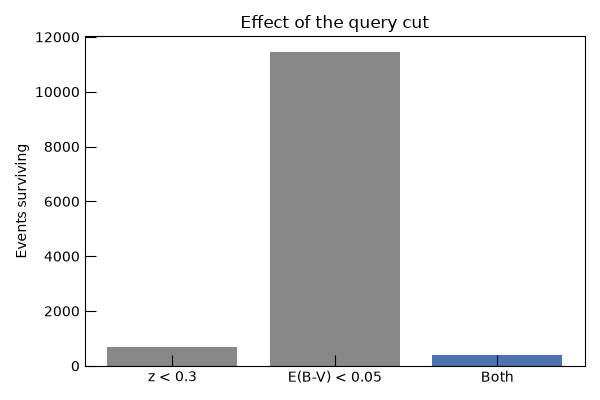
and/or/not. Here: nearby and lightly reddened by Milky Way dust.
low_z_low_ebv = simulator.filter_by_query(catalog, uvex, expr="(redshift < 0.3) & (ebv < 0.05)")
print(f"z < 0.3 and E(B-V) < 0.05: {len(low_z_low_ebv) * DOWNSAMPLE} events.")
z < 0.3 and E(B-V) < 0.05: 400 events.
Compared against the named filter_by_redshift/filter_by_query alone#
low_z_only = simulator.filter_by_query(catalog, uvex, expr="redshift < 0.3")
low_ebv_only = simulator.filter_by_query(catalog, uvex, expr="ebv < 0.05")

fig, ax = resolve_fig_axes(fig_size=(6, 4))
labels = ["z < 0.3", "E(B-V) < 0.05", "Both"]
counts = [len(low_z_only) * DOWNSAMPLE, len(low_ebv_only) * DOWNSAMPLE, len(low_z_low_ebv) * DOWNSAMPLE]
ax.bar(labels, counts, color=["#888888", "#888888", "#4C72B0"])
ax.set_ylabel("Events surviving")
ax.set_title("Effect of the query cut")
fig.tight_layout()
plt.show()
Total running time of the script: (0 minutes 8.963 seconds)